The crow is a fascinating bird that has traversed ages and cultures, embodying varied and often contradictory symbolism. Present in mythologies, popular beliefs, and religious narratives, this black bird is sometimes associated with wisdom and light, and at other times with death and curse. This article explores the multiple facets of crow symbolism across civilizations.
Celtic and Germanic Mythologies
In Celtic mythologies, the crow is closely linked to war and death. In Ireland, it is particularly associated with the goddess Morrigan, a complex and formidable figure embodying the darkest and wildest aspects of nature. Morrigan, often represented in the form of a crow, is a war goddess who transforms to influence the course of battles. Her connection to the crow underscores the bird’s role as an omen of death and a guide for the souls of fallen warriors.
This symbolism is also found in Gaul, where the goddess Bodb, also linked to war, bears the nickname “battle crow.” The crow, with its black color and scavenger behavior, is thus perceived as a messenger of death, a role also given to it in Germanic-Scandinavian mythology. The Valkyries, female deities in the service of Odin, transform into crows to designate the warriors who must die and guide them to Valhalla. In this tradition, the crow is not only a bird of death but also a psychopomp, a guide of souls to the afterlife.
In Norse mythology, they also represent creation and knowledge through the ravens Hugin (Thought) and Munin (Memory), faithful companions of Odin. They fly each day across the world to bring back to the god what they have seen and heard.
According to an interpretation by the Lyon Foundation, a flight of crows is said to have guided the first builders to the site of the future city, giving rise to the name Lugdunum, sometimes translated as “Hill of the Crow.” This story, though rooted in myth, reflects the symbolic significance of the crow in Gallic culture and its association with the god Lug as his favored bird.
The Crow in Greco-Roman Mythology
In Greece, the passerine is associated with Apollo, the god of the sun and divination. This connection reinforces the crow’s role as a divine messenger and prophetic bird. According to legend, it is a crow that warns Apollo of the infidelity of the nymph Coronis. As punishment for bringing bad news, Apollo turned the crow’s plumage, once white, to black. This story illustrates the ambiguity of the crow, bearer of both truth and curse.
For Athena, the crow was far too talkative and indiscreet, so she preferred to replace it with the owl. According to Ovid in the Metamorphoses (II, 559-632) and Callimachus, the goddess originally had a crow as her favored bird, which was actually Coronis, transformed into a crow after committing incest with her father. Athena granted her a place by her side, but she lost this favor due to her indiscretion when she revealed the secret of Erichthonius’s birth. As punishment, Athena replaced her with the owl, and the crow was banished from the Acropolis.
This episode is often associated with the rivalry between the crow and the owl, symbolizing the loss of divine favor. Antigonus of Carystus and Melesagoras also mention this legend, emphasizing the crow’s exclusion from the Acropolis, without explicitly stating that it was once Athena’s favored bird.
This bird also appears in Roman mythology, notably in the context of augury. Its flight was interpreted by diviners to predict the future. This divinatory function of the crow emphasizes its status as a mediator between gods and men, capable of revealing divine wills.
Asian Mythologies
In Asia, the crow is often associated with light and the sun, although this link is sometimes ambivalent. In China, the crow is a solar bird, symbolizing insight and vigilance. A myth tells that once, ten suns, each embodied by a crow, appeared simultaneously in the sky, threatening to burn the Earth. The celestial archer Yi was then tasked with shooting these suns, killing nine to leave only one. The slain crows fell to earth, transformed into black birds pierced by a white arrow. This myth reflects the idea that light, while necessary, can become destructive if not controlled.
In Japan, he is also a symbol of filial gratitude and familial love. It is revered as a divine messenger and a harbinger of good omens. The three-legged crow, a solar symbol, represents yang, the masculine creative energy. This symbol, visible on carved stones from the Han period in China, illustrates the importance of the crow in Asian cultures, where it is seen as a bearer of light and life.
In the Mahābhārata of India, crows are generally seen as messengers of the gods and the spirits of ancestors. They play a crucial role in Hindu funeral rites, where they are fed to honor the souls of the deceased, a practice reflected in the Shraddha rite, where offerings are made to crows as representatives of the ancestors.
In contrast, in the fable of the crow and the swans from this ancient Hindu epic, the bird embodies arrogance and the illusion of grandeur based on superficial attributes. Despite its claims and boastfulness, the crow is merely an ordinary bird, fed on the remains of others. Its attempt to compete with the swans, symbols of nobility and wisdom, reveals its inability to recognize its own limitations. Thus, the crow represents the folly of believing oneself superior without understanding one’s true nature, leading to humiliation and defeat.
Native American Culture
Among the indigenous peoples of North America, the crow is often seen as a creator hero and trickster. In the mythology of the Haida of British Columbia, the crow is a central figure. He is both the creator of the world and the one who stole the sun to give it to humanity. This story highlights the crow’s role as a bringer of light and life, but also its mischievous and unpredictable nature.
In other Native American traditions, this bird is considered a spiritual guide, a protector against dangers, and a messenger of the gods. Among the Tlingit, for example, the crow is revered for its ability to interact with the spiritual world and bring knowledge and power to humans. This symbolism is deeply rooted in the vision of the crow as a being on the boundary between the world of the living and that of the spirits.
Christian and European Tradition
In Europe, the symbolism of the crow is often negative, particularly in Christian tradition. The crow is sometimes seen as a symbol of sin and curse. In the Bible, it appears in the episode of the Flood: Noah first sends out a crow to check if the waters have receded, but the bird does not return, preferring to stay in a ruined world. This behavior is interpreted by some Church Fathers as a symbol of the sinner who refuses to return to God.
In contrast, for Saint Augustine, the crow’s caw evokes the Latin word cras, meaning “tomorrow,” which some Church Fathers interpreted as a symbol of hope.
In the Middle Ages, he is often seen as a harbinger of death. In popular traditions, the cry of a crow near a house or church is considered a sign of impending death. This dark symbolism is found in European tales and legends, where the crow is often associated with loneliness, war, and curse. However, it is interesting to note that this negative symbolism is relatively recent and seems to have developed with the sedentism and evolution of agricultural societies, contrasting with more positive visions of the crow in nomadic and hunting cultures.
Ominous Symbol in the Arts
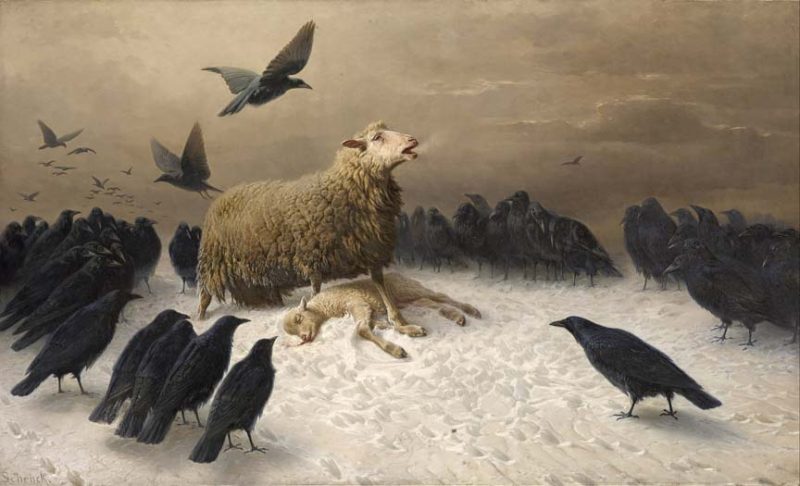
In painting and literature, the crow is once again linked to death, darkness, and desolation. In Romantic art, through the works of Caspar David Friedrich or August Friedrich Schenck, ravens in desolate landscapes amplify themes of melancholy, the passage of time, and the ineffable sadness of the world.
In Edgar Poe’s poem, the raven remains a bird of ill omen, symbolizing the “eternal mournful memory” of his lost beloved.
In James O’Barr’s comic book The Crow, we see the influence of Gothic and Romantic elements, where the psychopomp bird, bridging the world of the dead and the living, becomes the servant of justice.
The crow is a mythical bird with complex symbolism, oscillating between light and darkness, life and death, wisdom and curse. Across ages and cultures, it has been revered as a divine messenger, a spiritual guide, and feared as an omen of death. This duality might symbolize the dark side of the psyche that becomes beneficial once it has been tamed. It also reflects the richness of human myths and beliefs, where the crow occupies a central place as an intermediary between the visible and invisible worlds.
You liked this article? Discover more!