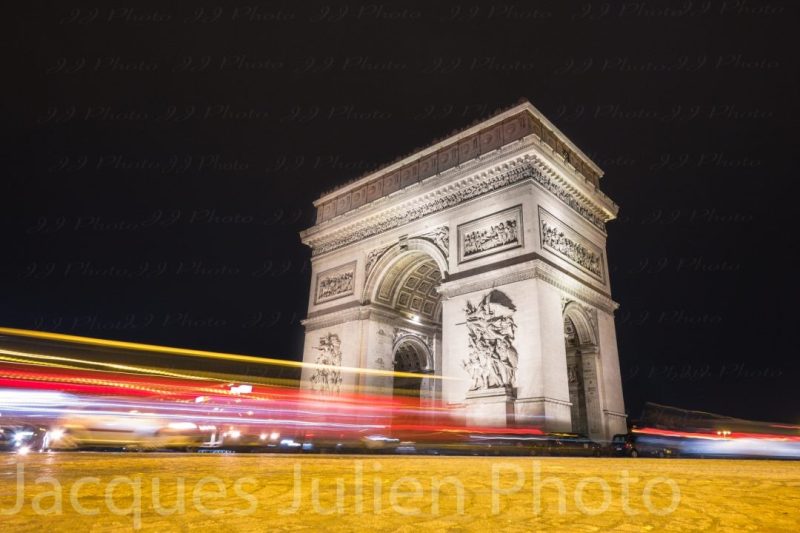
I made this photo of the Arc de Triomphe with the shutter speed sets to 1 second – f/7,1 – 400 Iso. I used the wide angle Fujifilm XF 14mm.
You can get this royalty-free stock photo in my library here.
Best subjects for long exposure shots
Not all subjects are equal when it comes to the long exposure technique. To achieve an artistic, even minimalist effect, it is crucial to photograph a subject in motion, even if the movement is very slow.
Capturing water, whether it’s the sea, a waterfall, or a river, will yield a smooth, almost milky result. This effect is enhanced when contrasted with a completely stationary element in the frame, such as a pontoon or rocks.
Clouds and the sky, especially at night with stars, make excellent subjects for long exposure, unlike stationary elements like trees or buildings.
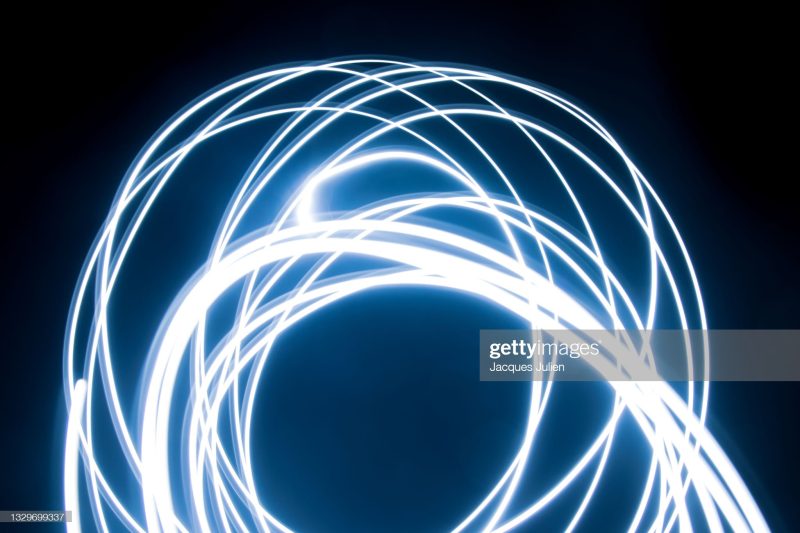
Long exposure reveals a new perspective on subjects like lightning, fireworks, light trails (using light painting) and even everyday scenes like crowded streets during the day. The key is to experiment.
Long exposure photography allows us to perceive the world at a different pace, providing a unique viewpoint. What makes this practice intriguing is that you’ll almost never capture the same photo twice. Like traditional photography, it plays with light to produce distinctive, one-of-a-kind results.
Twilight, sunrise, and sunset (“golden hour” and “blue hour”) are ideal times for long exposures, offering balanced light and dynamic skies.
Clouds moving across the frame, flowing water, or even passing traffic can add beautiful motion to an otherwise still scene.
Essential Technical Settings
Shutter speed
The essence of long exposure lies in slowing down the shutter speed. Depending on the subject and the desired effect, exposure times can range from half a second to several minutes. For example, around 1–2 seconds smooths waves softly, while exposures of 30 seconds or more can erase them completely, creating a dreamy, mist-like surface.
Aperture
To balance the longer exposure, use a smaller aperture (f/8 to f/16). This not only prevents overexposure but also increases depth of field — useful for landscape compositions.
ISO
Keep ISO as low as possible (usually ISO 100) to minimize digital noise during long exposures.
ND Filters and Importance of a Tripod
Long exposures during daylight often require a neutral density (ND) filter to reduce the amount of light reaching the sensor.
These filters act like sunglasses for your lens, allowing you to extend exposure times without overexposing the image.
-
ND8 → reduces light by 3 stops
-
ND64 → reduces light by 6 stops
-
ND1000 → reduces light by 10 stops (ideal for silky water effects under daylight and to photograph the sun!)
Stacking filters can achieve even longer exposures, but be mindful of color casts or vignetting.
Also a sturdy tripod is non-negotiable, even the slightest vibration can ruin a long exposure.
Use a remote shutter release or your camera’s self-timer to avoid camera shake when pressing the shutter.
If your camera has it, enable mirror lock-up (for DSLRs) to further reduce vibrations.
Post-processing tips
Slight adjustments in contrast and highlights can emphasize the ethereal aspect of the shot.
If shooting in RAW (recommended), you’ll have greater control over recovering shadows or highlights caused by long exposure lighting variations.
Long exposure photography is as much about patience as it is about technique. It invites the photographer to slow down and observe time itself — to transform motion into texture, and light into poetry. Whether it’s waves turning to silk, stars tracing circles, or city lights painting the night, each image is a dialogue between stillness and movement.
French photographer based in Paris. This site shows my wildlife and architecture photos, creative portraits, black and white street photos through various galleries, a stock photo library and photography services.