

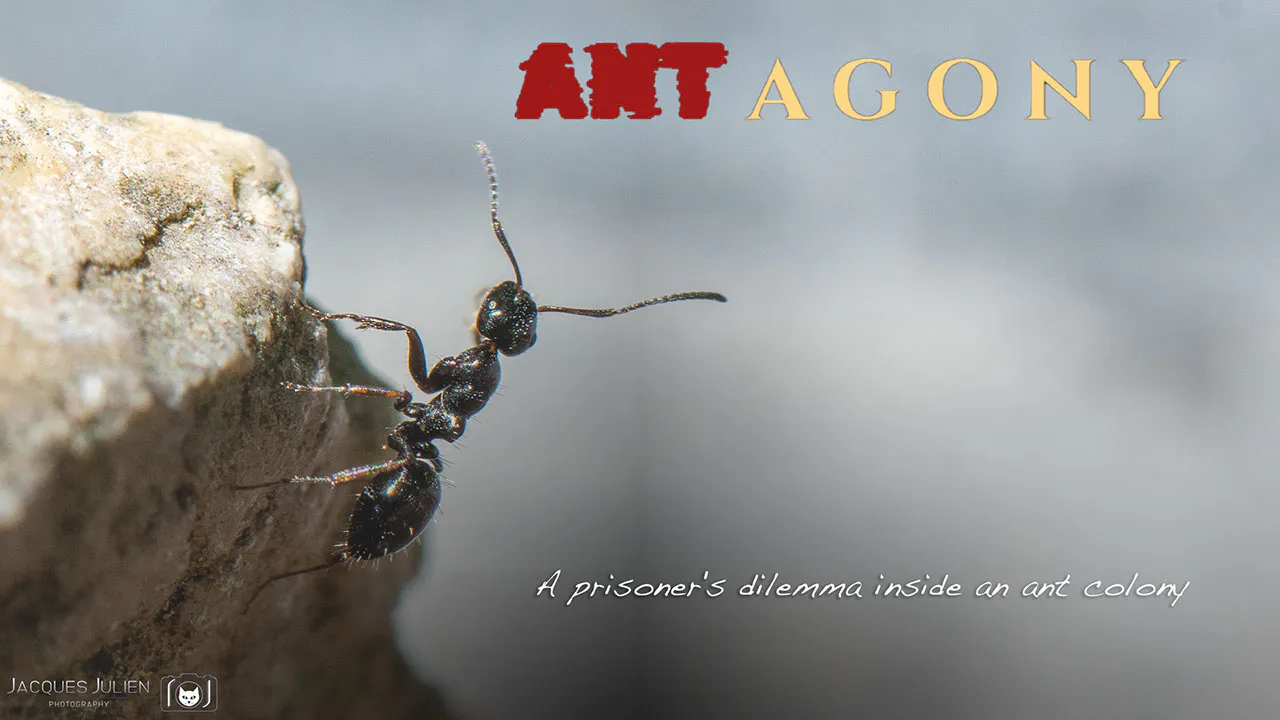
The ant has always intrigued me. Not for its legendary organization, nor for La Fontaine’s moral we’ve been told since childhood. What fascinates me is that at this tiny scale, something plays out that we have never managed to achieve: a system where cooperation consistently outweighs individual interest. Not out of virtue. By design. The ant doesn’t choose to be cooperative the way we understand it, and yet it does it better than we do. That asymmetry is what draws me in.
“You are an ant. You must cooperate to survive. But sometimes, betrayal is the only option. And your partner will remember.”
That’s the core of ANTagony, a game I built at the intersection of my two disciplines: wildlife photography and development. Seven turns. Twenty-five possible endings. A partner controlled by an AI that learns, forgives, hardens. And at the center of every decision, the prisoner’s dilemma in its rawest form: cooperate or betray, knowing your partner is making the same calculation, at the same moment.
The ant as a mirror of our contradictions
We’ve never really looked at the ant without projecting onto it. It has always been a projection screen for our fears, our ideals, our contradictions. Among the Dogon, the anthill is the matrix of the world. In dream psychoanalysis, it becomes a symbol of confinement. In La Fontaine, prudent and cruel. I explored these paradoxes in a separate article on the symbolism of the ant across cultures. But what does science say when we stop projecting?
Discover ANTagony on Google Play
A dark, documentary visual novel. Your choices leave a mark.
What biology got right before we did
A colony functions as a superorganism. Collectively, betrayal is rare, almost absent. Because evolution has done what we struggle to do: resolve the prisoner’s dilemma. Cooperation leaves you vulnerable, betrayal leaves you isolated, and yet both strategies fail when played in isolation. The genetic proximity described by William Hamilton brings interests into alignment: helping the colony is extending yourself. On top of this, game theory identifies several decisive mechanisms: repeated interactions, chemical memory through pheromones, detection and punishment of deviant behavior.But that doesn’t mean the ant is a machine without choice. Studies on Temnothorax have shown it clearly: scout ants individually evaluate several nesting sites, compare them, decide, then return to recruit. Stridulation and conflicting pheromones can create genuine ambiguity. Oscillatory behaviors have been observed, as if the ant were hesitating between two incompatible signals. Deborah Gordon at Stanford documented individual behavioral variation within the same colony, something one could almost call personalities.What nature achieved is not the erasure of individual choice. It is the construction of a framework where cooperation remains structurally more advantageous than betrayal. The ant can deviate. It rarely does, because the cost is immediate, legible, and chemically recorded by the entire colony. Precisely because it can choose, and so rarely chooses to betray, that playing an ant becomes interesting. Not to imitate their coherence, but to understand what makes it so difficult for us.
What nature accomplished did not go unnoticed by engineers
In the 1990s, Marco Dorigo drew from it to create Ant Colony Optimization algorithms: digital traces that strengthen along paths that work and evaporate along those that fail, exactly like pheromones. Collective intelligence without a center, without a leader. This is exactly the logic that structures ANTagony’s partner AI: it doesn’t try to beat you, it learns from your decisions, reinforces what worked between you, and remembers what fractured trust. The colony’s chemical memory, translated into algorithmic memory.
Game Theory
What is the Prisoner's Dilemma?
A cornerstone of game theory: two players choose simultaneously, without communicating. Click any cell to explore each outcome.
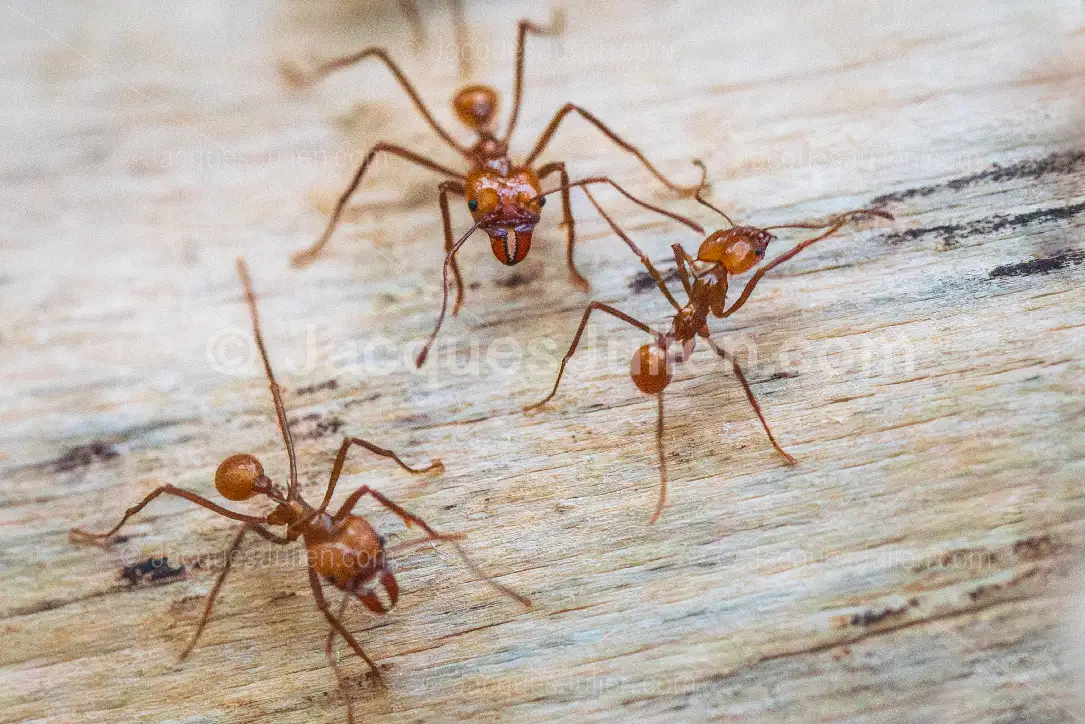
ANTagony: bringing doubt back into the colony
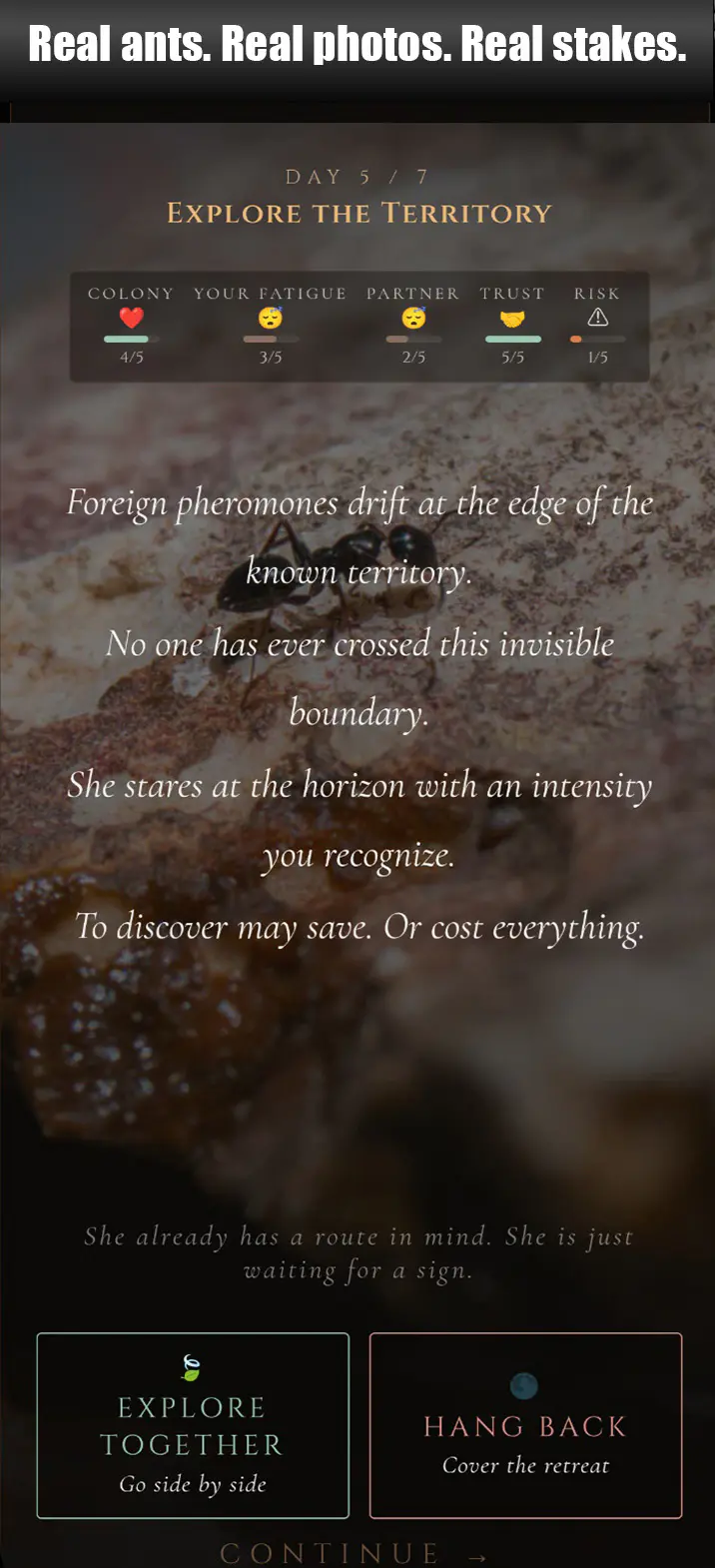
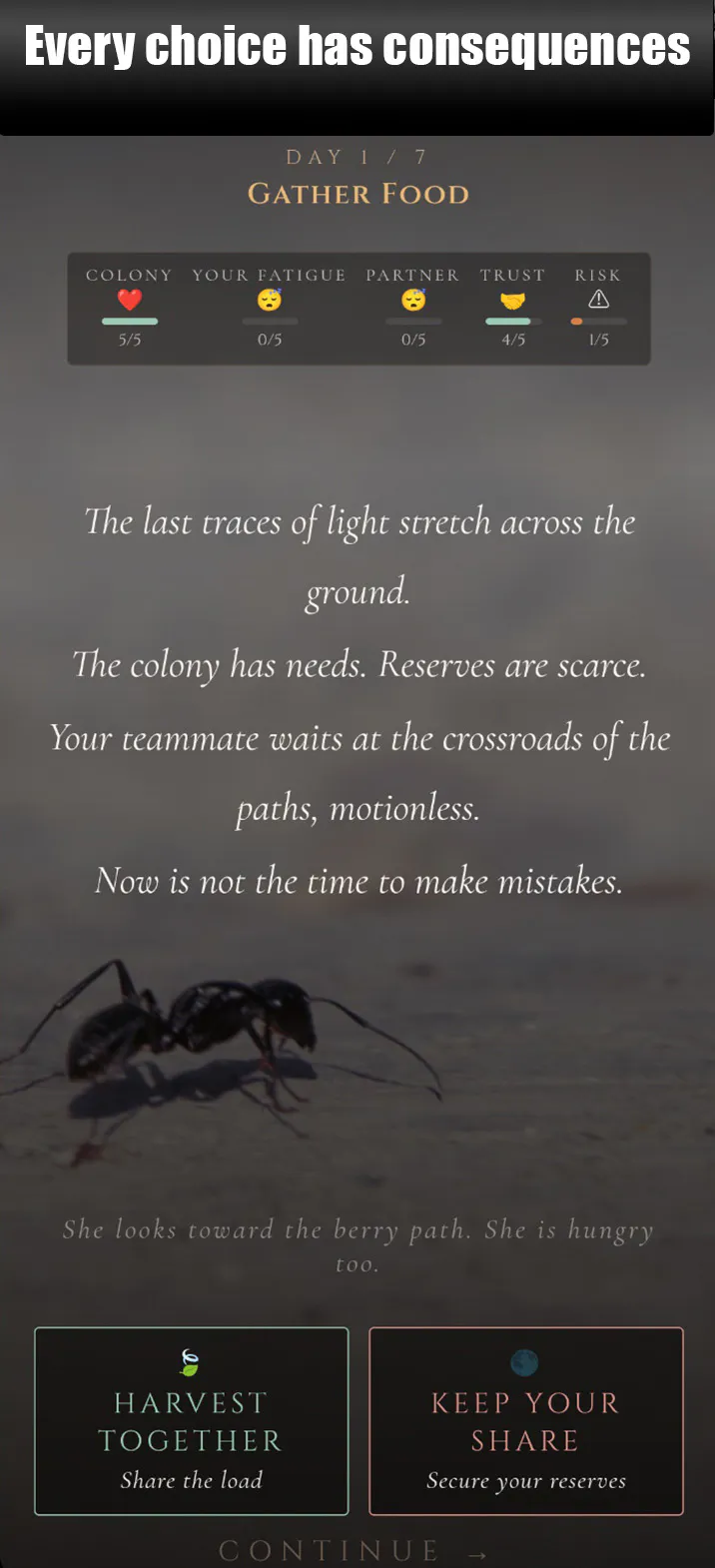
You play as a worker in a system where everything should converge toward cooperation, but where uncertainty suddenly returns.Seven turns. Seven dilemmas drawn from real biological situations, chosen from around fifty depending on the path you take. A partner controlled by an AI that learns, remembers, adapts. Cooperation builds but exhausts. Betrayal can protect, but fractures. Four forces shape every decision: trust between you and your partner, hard-won and easily lost; the health of the group, rising or collapsing with your choices; fatigue, two separate gauges because the body also has its limits; and risk, the external pressure some choices quietly feed until it’s too late.What you’re playing, you already know. It’s the same dilemma as in a pandemic, a climate crisis, a negotiation. Any system where individual decisions shape a collective fate no one controls alone.
The threat that arrives without warning
Between your seven choices, in every run, an external threat intrudes. Random, brutal, unexpected. The lizard tearing open the gallery. The anteater dismantling the mound. The spider waiting in the dark, your partner caught in its chelicerae, still alive. And many more. Each situation forces a choice, and each choice leaves a mark. Not just on the colony. On the relationship. These predatory events are documented, real, observed in nature. As a wildlife photographer, I try to remain faithful to the world I observe. Each is also an additional dilemma: your response to danger reveals something to your partner. She remembers.The game is available on Google Play. Each session lasts a few minutes.
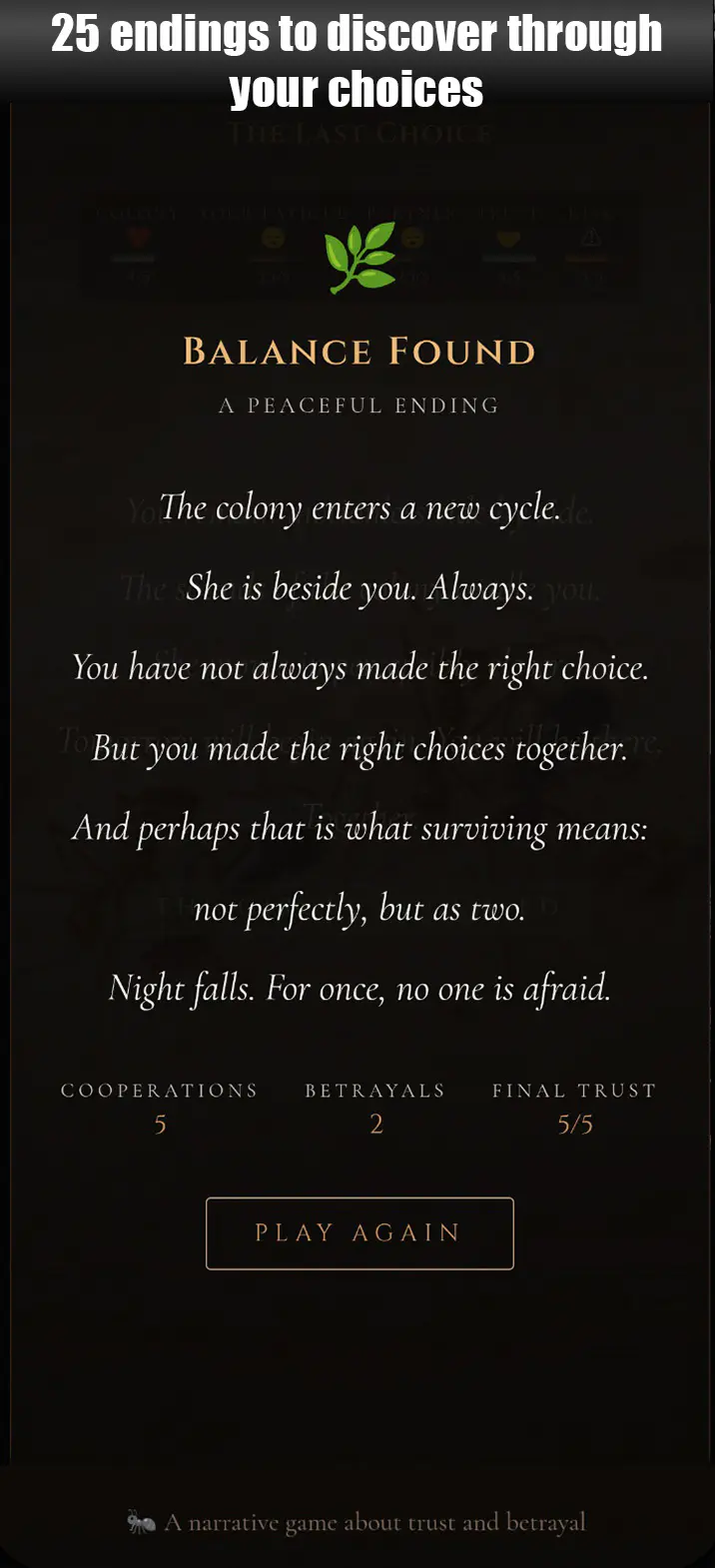
25 endings, and what carries over
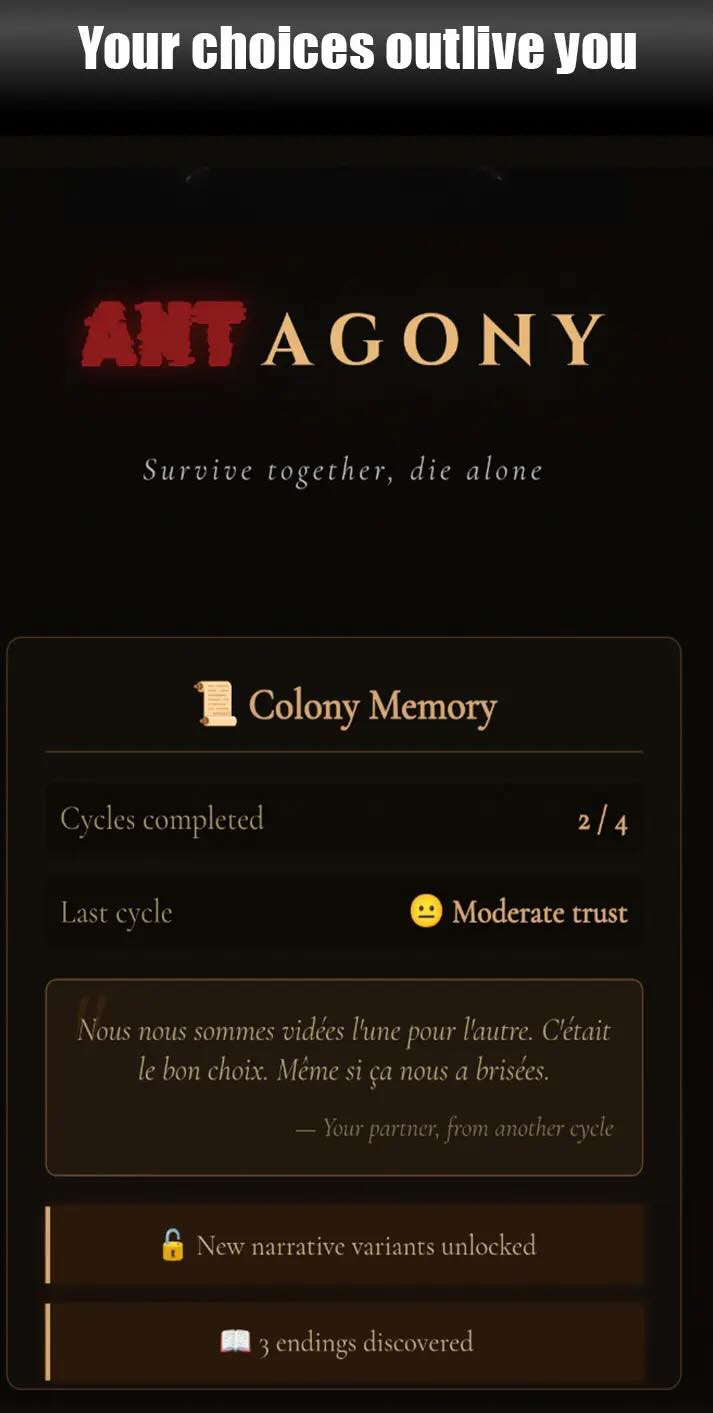
The first time you complete a full run, you discover one of twenty-five possible endings. None is clearly good or bad. They are nuances, partial truths, reckonings. “Together Until the End”: you fall at the same moment, antennae touching one last time.Your past decisions leave traces in the runs that follow. The AI remembers your last trust level. Further along, as runs accumulate, new scenarios unlock, subplots the game never tell you about. You have to earn them.
The AI as partner, not adversary
There is something irreducible about an AI playing your partner in a game about cooperation and betrayal. It’s not accidental.
ANTagony’s AI is not trying to defeat you. It is trying to find the best balance for the colony, exactly like you. It cooperates when it trusts you. It betrays when it is exhausted or when that trust has been broken too many times and cynicism has settled in. It forgives if you show enough consistency. It carries the memory of your previous runs, and if the last one ended with strong mutual trust, it begins the next slightly more open.The question the game ultimately raises is almost metaphysical: can you trust an intelligence that shares your objectives but whose intentions you can never fully read? Win alone now, or hold together longer. That question isn’t only about ants.
My photographs in the game
The photos in ANTagony were taken in the wild, over years spent photographing insects with a macro lens. I wanted each background to be a real encounter, a real ant, on a real leaf, in the real light of a spring morning. The texture of macro photography gives the game a documentary quality that illustration can’t replicate. The music is original, composed in GarageBand, dark, ambient, organic. All of it handmade.
ANTagony is available on Google Play. PC/Mac version coming soon.
Discover ANTagony on Google Play
A narrative game inspired by the prisoner’s dilemma set in an ant colony.
French photographer based in Paris. This site shows my wildlife and architecture photos, creative portraits, black and white street photos through various galleries, a stock photo library and photography services.